

Most networked software treats applications as the primary unit of deployment. A backend hosts an application, the application owns a database, and objects such as documents, wallets, feeds, vaults, or agents are represented as records inside that application’s storage model.
Seed Nodes suggest a different architecture.
In Seed, the node does not primarily host applications. It hosts state-construction protocols. A document, wallet, vault, notification feed, or agent is not fundamentally an app module or a data type. It is a protocol-defined object: a message grammar, a verification contract, a deterministic state-transition function, and a set of invariants that define the object's stable reality.
The Seed node can therefore be understood as a deterministic verifier and state builder: a machine that converts authenticated, causally ordered message streams into reproducible object states.
This shift moves object innovation out of application backends and into protocol definitions. New object types are introduced not by deploying new SaaS applications, but by defining new protocols and contracts that the generic daemon can verify, replay, reduce, replicate, and snapshot.
Seed is thus closer to the Internet model of extensibility — introduce a new protocol — than to the SaaS model of extensibility — deploy a new backend.
1. The Core Shift
The conventional mental model is:
A node hosts applications.
Seed’s deeper architectural model is:
A node hosts state-construction protocols.
An application-centric node serves app-specific logic. It knows what a document app, wallet app, or feed app is because those concepts are built into the software stack. Each application brings its own server, database schema, authorization model, synchronization logic, and conflict handling.
A protocol-centric node instead provides generic infrastructure for constructing stable state from distributed intent. It does not need to understand “document,” “wallet,” “vault,” or “agent” as hardcoded application categories. It only needs to understand how to execute protocol contracts.
Under this model, an object is not primarily a database row or API resource. An object is a reproducible state derived from an authenticated stream of admissible messages.
Seed’s daemon is therefore not merely a document server. It is a generalized substrate for protocol execution.
2. Protocol-Defined Objects
A Seed object can be defined as a protocol-governed reality produced by message reduction.
Each object protocol defines at least four things:
Message grammar
What messages may exist for this object type?
Verification contract
Which messages are valid, authorized, authenticated, and causally admissible?
State-transition function
Given a current state and an admissible message, what next state follows?
Stable invariants
What properties must hold for the object state to be considered valid, canonical, or stable?
This means a “document,” “wallet,” “vault,” “feed,” or “agent” is not merely a datatype. It is a state machine plus a contract.
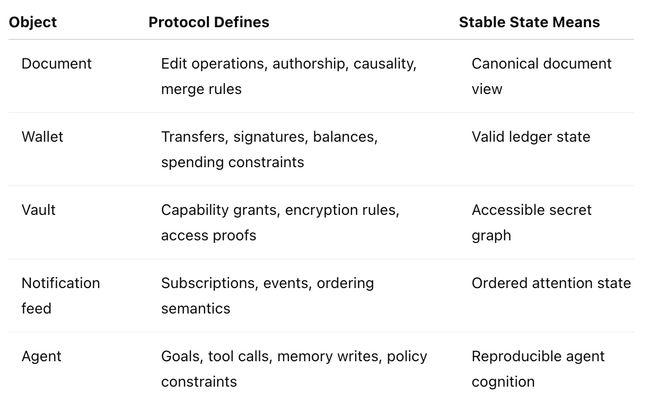
Objects become protocol-defined realities rather than database records.
3. The Node as Verifier and State Builder
State building: given all admissible messages, what reality follows?
These two responsibilities are related but distinct.
3.1 Verification
Verification answers questions such as:
Is this message well-formed?
Is it signed by the appropriate authority?
Is it authorized under the object’s capability model?
Does it reference valid causal dependencies?
Does it satisfy the protocol’s admissibility constraints?
Can this message exist in this object’s history?
Verification determines whether a message may enter the object’s admissible event stream.
3.2 State Building
State building answers a different question:
Given all admissible messages, what object state follows?
This is the underappreciated half of distributed truth.
Many systems verify messages, signatures, permissions, and API calls. Fewer systems rigorously define deterministic global state construction. Without deterministic state construction, peers may agree that individual messages are valid while disagreeing about the object those messages imply.
Seed’s state builder reduces admissible message history into stable object reality.
The node therefore becomes:
A deterministic verifier that converts authenticated message streams into reproducible object states.
Or, more broadly:
A machine for constructing globally meaningful state from distributed intent.
4. Stable State from Distributed Intent
Distributed systems are not merely systems with many machines. They are systems in which no participant has immediate access to total reality. Each peer observes partial messages, local clocks, delayed deliveries, conflicting updates, and incomplete causal knowledge.
The hard problem is not simply moving data between machines. The hard problem is deriving coherent state from partial, asynchronous observations.
Seed addresses this by treating object state as something continuously reconstructed from authenticated message streams.
An object is not stored once and then served. It is repeatedly recoverable. It can be replayed, snapshotted, verified, replicated, and independently reconstructed by any peer with access to the relevant messages and protocol definition.
This gives Seed objects several important properties:
Reproducibility: the same admissible history produces the same state.
Auditability: state can be traced back to the messages that constructed it.
Portability: objects are not trapped inside one application backend.
Replicability: independent peers can reconstruct the same object reality.
Protocol extensibility: new object types require new protocols, not new daemon architectures.
Seed objects can therefore be understood as continuously reconstructed distributed snapshots.
5. The Generic Daemon
The Seed daemon remains generic because its responsibilities are infrastructural rather than application-specific.
It provides common services needed by many object protocols:
Signature verification
Identity and authority checks
Causal ordering
Message replay
Deterministic reduction
Conflict resolution hooks
Snapshotting
State proofs
Replication
Protocol negotiation
Stable-state construction
These responsibilities are independent of any particular domain object.
The daemon does not need to know, in advance, every possible object humans may want to create. Instead, it needs to provide a robust substrate on which protocol-defined objects can be executed.
This is analogous to how a virtual machine provides execution primitives without hardcoding every program that will run on it.
An Erlang VM provides concurrency, supervision, message passing, and fault tolerance for actor processes. Seed provides verification, causality, replay, reduction, replication, and snapshotting for persistent distributed objects.
Seed’s substrate is not centered on lightweight processes. It is centered on durable, protocol-defined object realities.
6. Object Innovation at the Protocol Layer
The architectural law is:
Each new object requires defining a protocol and contract.
This has major consequences.
First, the daemon remains generic. It does not grow a new backend for each new object category.
Second, object innovation happens at the protocol layer. Developers introduce new object types by specifying message grammars, verification contracts, state transitions, and invariants.
Third, the ecosystem evolves by introducing new state machines rather than deploying new centralized applications.
This makes Seed closer to the Internet than to SaaS.
The Internet grew because new protocols could be introduced over a common network substrate. Email, the web, DNS, file transfer, chat, and streaming did not require one universal application backend. They required protocols that could interoperate over shared infrastructure.
Seed applies a similar logic to object state.
Instead of asking, “What application owns this object?” Seed asks:
What protocol constructs this object’s state?
7. From Applications to Protocol Realities
Application-centric systems produce objects that are meaningful inside application boundaries. A document in one SaaS product, a wallet in another, a feed in another, and an agent memory in another are all bound to separate backends, schemas, permission systems, and lifecycle assumptions.
Protocol-centric systems produce objects that are meaningful across participants who understand the protocol.
This changes the unit of interoperability.
In SaaS, interoperability is usually achieved through APIs between applications.
In Seed, interoperability can happen through shared state-construction rules. If peers can verify the same messages and reduce them under the same protocol, they can derive the same object state without relying on one application server as the source of truth.
The object’s reality is not granted by a platform. It is constructed by protocol execution.
8. Implications for Seed Hypermedia
Seed Hypermedia began with documents, but this framing suggests a broader substrate.
A hypermedia document is one instance of a general pattern:
Authenticated authors express intent through messages.
Messages reference prior causal context.
A protocol verifies admissibility.
A reducer constructs canonical state.
Peers replicate, replay, and snapshot that state.
Once this pattern is generalized, documents are no longer the only possible object. The same substrate can support wallets, vaults, feeds, agents, organizations, governance records, knowledge graphs, software packages, or other persistent distributed objects.
The daemon does not become a giant monolith of applications. It becomes a small, rigorous execution substrate for many object protocols.
This is the strategic expansion:
From decentralized documents to decentralized object realities.
9. Design Principles
Seed’s protocol execution substrate should be guided by several principles.
9.1 Determinism
Given the same protocol definition and admissible message history, peers should derive the same state.
9.2 Verifiability
Peers should be able to verify why a message was admitted, rejected, or reduced into a particular state.
9.3 Causal Explicitness
Object histories should make causal dependencies visible enough to support replay, merge, conflict handling, and partial synchronization.
9.4 Protocol Modularity
New object types should be added through protocol definitions rather than daemon rewrites.
9.5 Stable Invariants
Each protocol should define the properties that must remain true across all valid state transitions.
9.6 Replayability
Object state should be reconstructible from message history, with snapshots used as optimization rather than as the sole source of truth.
9.7 Replication Without Platform Ownership
Object state should not depend on a single application backend remaining available.
10. Conclusion
Seed can be understood as a protocol execution substrate for persistent distributed objects.
The node does not host applications. It hosts protocols that construct state.
A document, wallet, vault, feed, or agent is not fundamentally an app-specific datatype. It is a message grammar, a verification contract, a state-transition function, and a set of invariants.
The daemon’s role is to verify messages, order them causally, replay histories, reduce admissible streams into deterministic states, produce snapshots and proofs, and replicate object realities across peers.
State building determines what reality follows.
By separating these responsibilities, Seed can remain generic while enabling an open-ended ecosystem of protocol-defined objects.
The result is not merely a decentralized document system. It is a machine for constructing globally meaningful state from distributed intent.
Working Thesis
Seed is a deterministic protocol execution substrate where authenticated message streams are verified, causally organized, and reduced into reproducible object states. Applications become views and interaction surfaces; protocols become the source of object reality.
Do you like what you are reading? Subscribe to receive updates.
Unsubscribe anytime